Emergency and Exit Light Testing in NJ
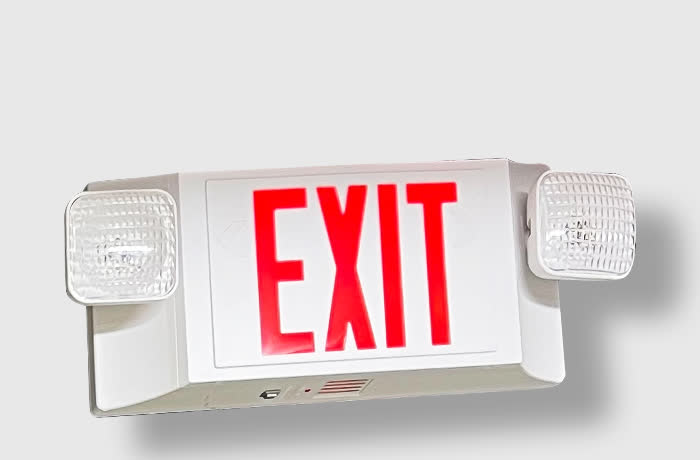
Emergency lights and lit exit signs do nothing on a normal day. They matter when the power fails and people need to find the door. Because of that, they have to be tested on a schedule, and the tests have to be written down. This page covers what the testing involves for New Jersey businesses. For our full service, see emergency lights and exit signs.
What NFPA 101 requires
NFPA 101, the Life Safety Code, covers emergency lighting testing in section 7.9.3. The basics are two tests:
- Monthly: a functional test of at least 30 seconds.
- Annually: a test of 1.5 hours (90 minutes) on battery power.
Your local fire official enforces the code that applies to your building, so that is the person whose expectations count.
The monthly 30-second test
The monthly test is a quick check that the unit switches to battery and lights up. Most units have a test button. Press and hold it for at least 30 seconds and confirm that the lamps come on and stay on, then release it and confirm the unit returns to normal and the charging indicator comes back on. Write down the date, the unit, and the result.
The annual 90-minute test
The yearly test is the real one. The unit runs on its battery for a full 1.5 hours, which is the length of time the light is expected to keep working if the power stays off. A battery can pass a 30-second test and still die at minute 40, which is why the long test exists. Any unit that goes dim or goes out before 90 minutes has failed and needs attention.
Written records
Testing counts only if it is documented. NFPA 101 calls for written records of the tests, kept for inspection by the authority having jurisdiction, which for most businesses is the local fire official. Keep written test records available for your fire official. Some local fire officials publish their own log forms, so it is worth asking yours whether one is expected. A simple record lists the date, the location of each unit, the test performed, the result, and who did it.
Making the tests easy to keep up with
The simplest way to stay current is to count your units once, number them, and keep one sheet that lists every fixture by location. Put the monthly test on the calendar the same day each month and the annual test on the same month each year. When a unit fails, note the failure and the fix on the same sheet. That way the next inspection starts from a clean, readable history instead of a scramble for paperwork.
What fails, and why
When a unit fails a test, the cause is almost always one of three things:
- Batteries. They wear out. A battery that cannot hold a charge will fail the 90-minute test.
- Lamps and LEDs. A burned-out lamp or a failed LED board means no light even when the battery is fine.
- Charging circuits. If the unit never charges properly, the battery runs down no matter how new it is.
Our posts on causes of emergency light failure and routine maintenance tasks cover these in more depth.
What Atlantic does
Atlantic Fire Protection tests, repairs, and replaces emergency lights and exit signs. We run the tests, tag the units that pass, change batteries and lamps, and replace the whole fixture when a repair will not make it pass. We come to your building in New Jersey and Eastern Pennsylvania, excluding Philadelphia, and our office is in Toms River. See also how to replace exit lights when they burn out.
Frequently asked questions
How long does the annual emergency light test take?
The annual test runs the unit on battery for 1.5 hours (90 minutes), and the unit has to stay lit the whole time.
Do I have to keep records of the tests?
Yes. NFPA 101 calls for written records, kept for inspection by the authority having jurisdiction. Keep written test records available for your fire official.
What do you do when a unit fails?
We find the cause, usually the battery, the lamp or LED, or the charging circuit, and repair or replace the unit.
Does the fire department have its own log form?
Some local fire officials publish their own log forms. Ask yours whether it uses one.
Call Atlantic Fire Protection
Call New Jersey at (732) 443-0608 or Eastern Pennsylvania at (484) 214-1800. Office hours are Monday to Friday, 8am to 5pm, and emergency service is available 24/7. Our office is at 1745 US 9, Unit 9, Toms River, NJ 08755.